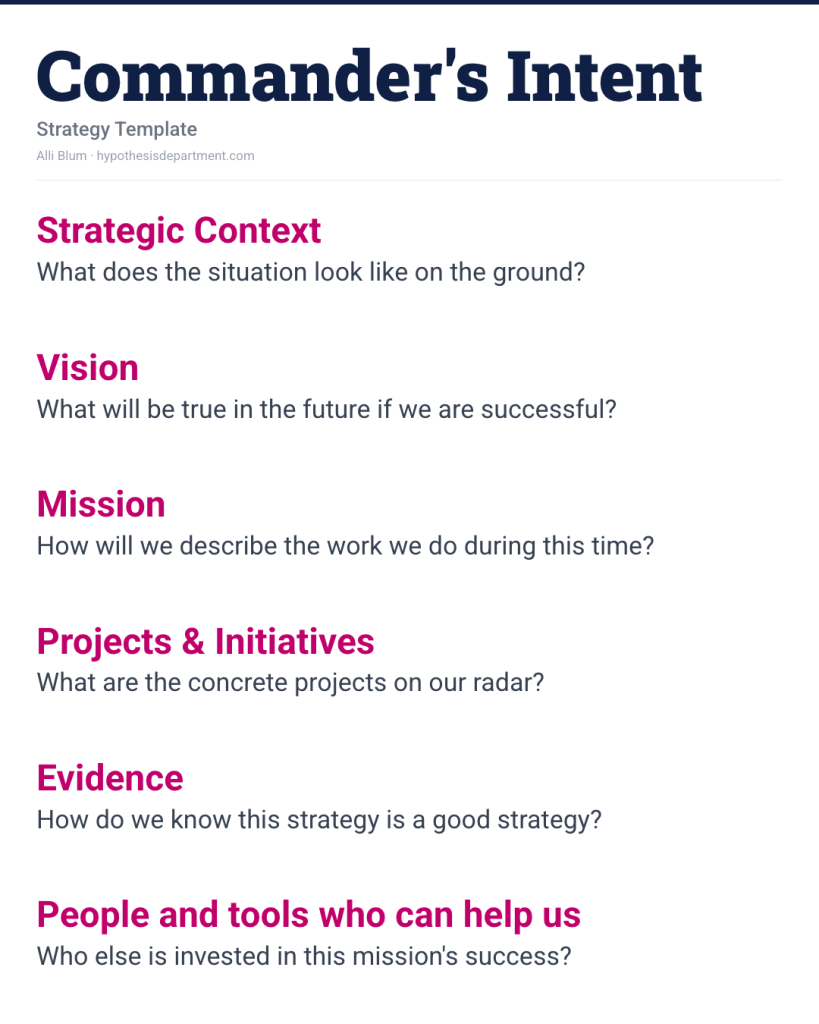
This is the Commander’s Intent strategy framework I used to help my teammates navigate the ambiguous moment of launching a new product from 0-1.
It’s a leadership framework of military origin (Prussian then American).
I have found it useful for asking others to help you transform an ambiguous vision that lives inside your head into a concrete reality that someone can point to in the real world and say, “Look, we built that!”
When we were preparing to launch this product, the team was operating within at least 3 zones of ambiguity:
Who are we building for? Each person had served a different user group than the one we were asking them to understand and build for in this launch.
What will the output look like? We had a short window to get our MVP up and running to make the most of an external deadline. We made a judgement call that our time would be better getting _something_ live by this deadline rather than invest heavily in prototyping.
How will success be measured for this project? Each team member had previously been a high-performer, routinely meeting already-defined success metrics on another established product. We were asking everyone to abandon those success metrics and start reaching for something that could not yet be measured in a dashboard.
So how do you guide a team to build a thing they haven’t built before, for an audience they haven’t served before, in an environment where everything everyone previously knew about what success looked like is out the window?
I reached for Commander’s Intent, a framework a colleague had shared with me years prior.
He told me about how Southwest Airlines CEO Herb Kelleher used it to enable each team member to know they were making decisions to advance the company mission.
Legend has it that he said something like, “My Commander’s Intent is this: We’re going to be THE low cost airline. If a decision allows the company to maintain low fares, we make it. If not, we don’t.”
Legend continues that flyer feedback revealed off-the-charts demand for in-flight chicken sandwiches. But when they ran the numbers, they found that meeting this demand would increase costs and inhibit the company’s ability to be THE low cost airline. The chickens stayed on the ground.
The leadership strategy doesn’t say anything about chicken sandwiches. Or in-flight waste disposal. Or how to run check-in counters. It doesn’t name the countless decisions with departmentally-specific considerations that influence whether a decision is a good or bad.
But it does is give team members a way to say, “There are many ways I could accomplish this task or make this decision, the most important thing to keep in mind is whether and how it supports the mission.”
For a 0->1 team working on a new product with neither a detailed understanding of our users nor a clear path to measure their performance, Commander’s Intent gave us a way to say,
“Here’s what ‘Mission Accomplished’ looks like.”